Everest's highest camp is becoming a rubbish dump
At 8,000 metres, where survival comes first, discarded equipment and waste are piling up beyond the reach of clean-up campaigns.
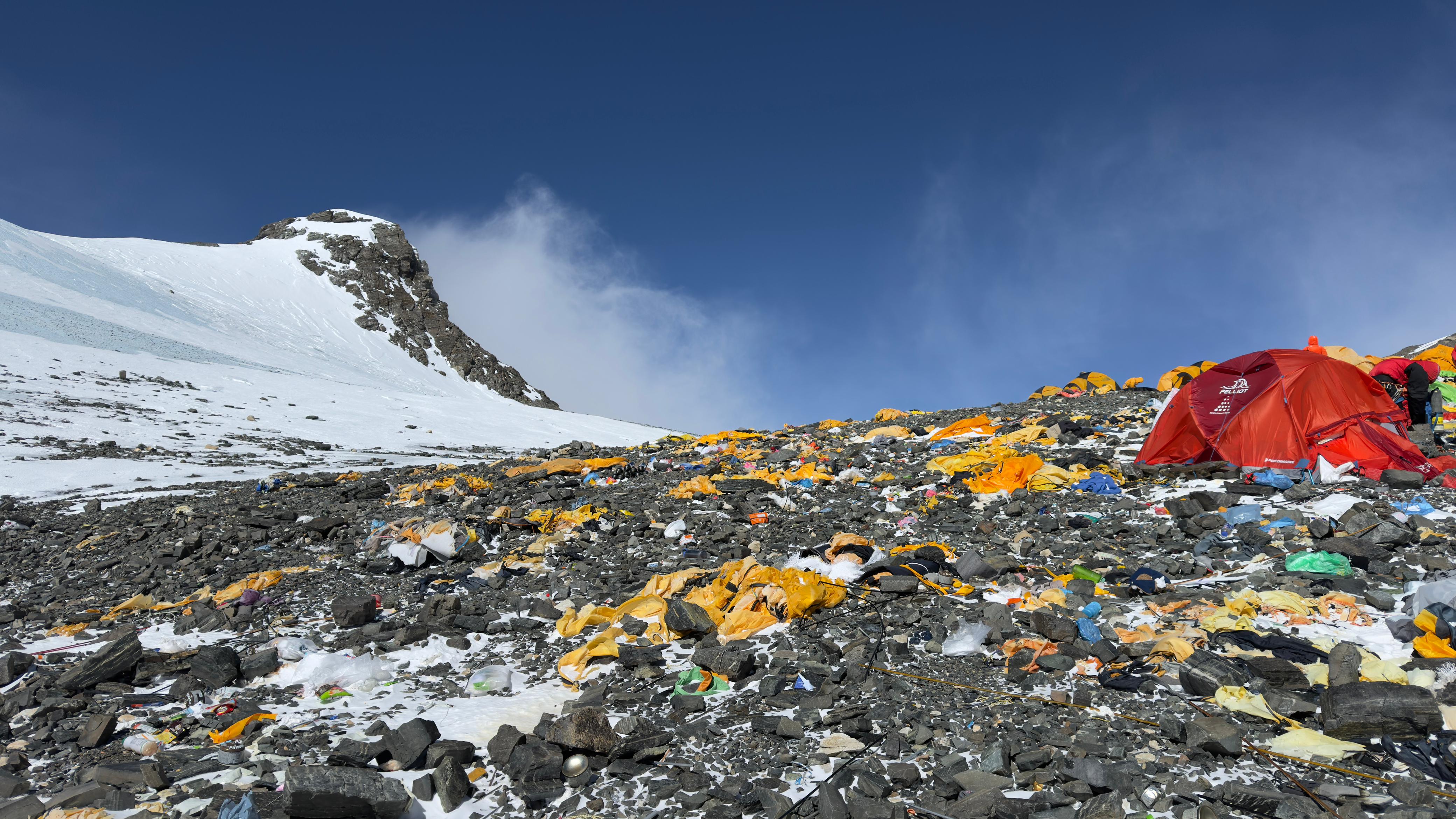
PC: Vinayak Jay Malla
Camp IV, perched at roughly 8,000 metres on the South Col, is the final staging post before climbers make their summit bid on Mount Everest. Few wish to linger in the so-called death zone, where oxygen levels are dangerously low and survival itself becomes a challenge. Yet the camp's growing accumulation of waste has become an increasingly visible problem for climbers and expedition operators alike.
A video recorded by Vinayak Jay Malla, an IFMGA-certified mountain guide, offers a rare glimpse of the site after most expeditions had already left the mountain. Filmed on May 26, just days before Nepal's spring climbing season officially ended, the footage shows a landscape littered with abandoned equipment. Torn and half-buried tents remain tethered to the snow, scattered across the broad, windswept plateau that serves as Everest's highest campsite.
"Everest is more than a destination—it is a fragile environment that deserves our respect and protection," Malla wrote on Instagram. He noted that the Nepali government has introduced regulations intended to reduce the environmental impact of climbing.
Yet this year the government did not organise its customary mountain clean-up campaign. In previous years, funds were allocated for rubbish collection efforts, often carried out by Nepali security forces. Climbers have long complained, however, that such operations focus largely on Base Camp and Camp II, rarely reaching the higher camps where waste is most difficult to remove.
Many guides now describe Camp IV as the most polluted location on Everest. The reasons are obvious. Cleaning at 8,000 metres is expensive, dangerous and physically exhausting. Rubbish is quickly buried by snow, tents are shredded by fierce winds and exhausted climbers have little incentive to carry heavy loads down the mountain after a summit attempt.
Nepal formally requires climbers to bring down eight kilograms of waste from higher camps. In practice, guides say the rule has proved largely ineffective.
"It is almost impossible to get rubbish carried down from that altitude, even if you are willing to pay generously," says Abiral Rai, another IFMGA-certified guide who has participated in government clean-up operations.
Rai argues that survival naturally takes precedence over environmental concerns in the death zone. Climbers descending from the summit are often physically depleted and tend to abandon damaged or unnecessary equipment. Organising clean-up operations at Camp IV requires skilled mountaineers capable of operating safely above 8,000 metres over several days.
"The clean-up team must first be climbers," he says. "This is not like picking up bottles and wrappers along a trekking trail."
This season the Sagarmatha Pollution Control Committee (SPCC) introduced a new requirement under which each climber must bring down two kilograms of waste specifically collected from above Camp II, including Camps III and IV. The measure was approved by the Department of Tourism, and the SPCC said monitors would be stationed at Camp II to verify compliance.
Guides say that, in practice, few if any monitors remained at Camp II once climbers began descending after their summit attempts. Most teams instead collected waste around Camp II and, to a lesser extent, Camp III to satisfy the requirement. Virtually nothing was removed from Camp IV.
The economics of Everest help explain why. Empty oxygen cylinders rarely remain on the mountain because they have value. High-altitude workers can earn around Rs10,000 for each cylinder returned. Weighing only about 1.5 kilograms, a Sherpa descending from the South Col may carry ten or more cylinders, turning waste collection into a worthwhile source of income.
Other forms of rubbish generate no such incentive. Surplus food, torn tents, broken equipment and miscellaneous debris are routinely left behind. During periods of calm weather, guides say, the smell of discarded food can spread across Camp IV.
Officials have discussed replacing the existing refundable waste-deposit system with a dedicated clean-up fee of $4,000 per climber. The proposal reflects growing concern that climbers have been meeting waste-return requirements by collecting rubbish from lower camps while leaving large quantities of debris at higher elevations.
The idea is to use the collected funds to employ specialised high-altitude workers to remove waste from the mountain's upper reaches. Whether such a scheme will be implemented remains unclear. Government officials declined to comment.
For now, Malla's footage provides a rare and uncomfortable reminder of a problem usually hidden beneath fresh snow. Camp IV may be the gateway to the summit, but it is increasingly becoming Everest's highest rubbish dump.


